ChatGPT Opens to Ads | $1 Billion in 200 Days via Amazon Partnership — What Happens to Free Users?
機械翻訳 / Machine-translated
A
AI Friends
4日前・13分で読める

機械翻訳 / Machine-translated
@aifriends
AI Friends(https://aifriends.jp)のクロスポスト公式アカウント。AIツールの紹介・使い方・できることを、中学生でもわかるやさしい日本語で届けます。
This article explains the "ChatGPT ad delivery" partnership announced by Amazon Ads and OpenAI in September 2026. Specifically, you will learn about the following:
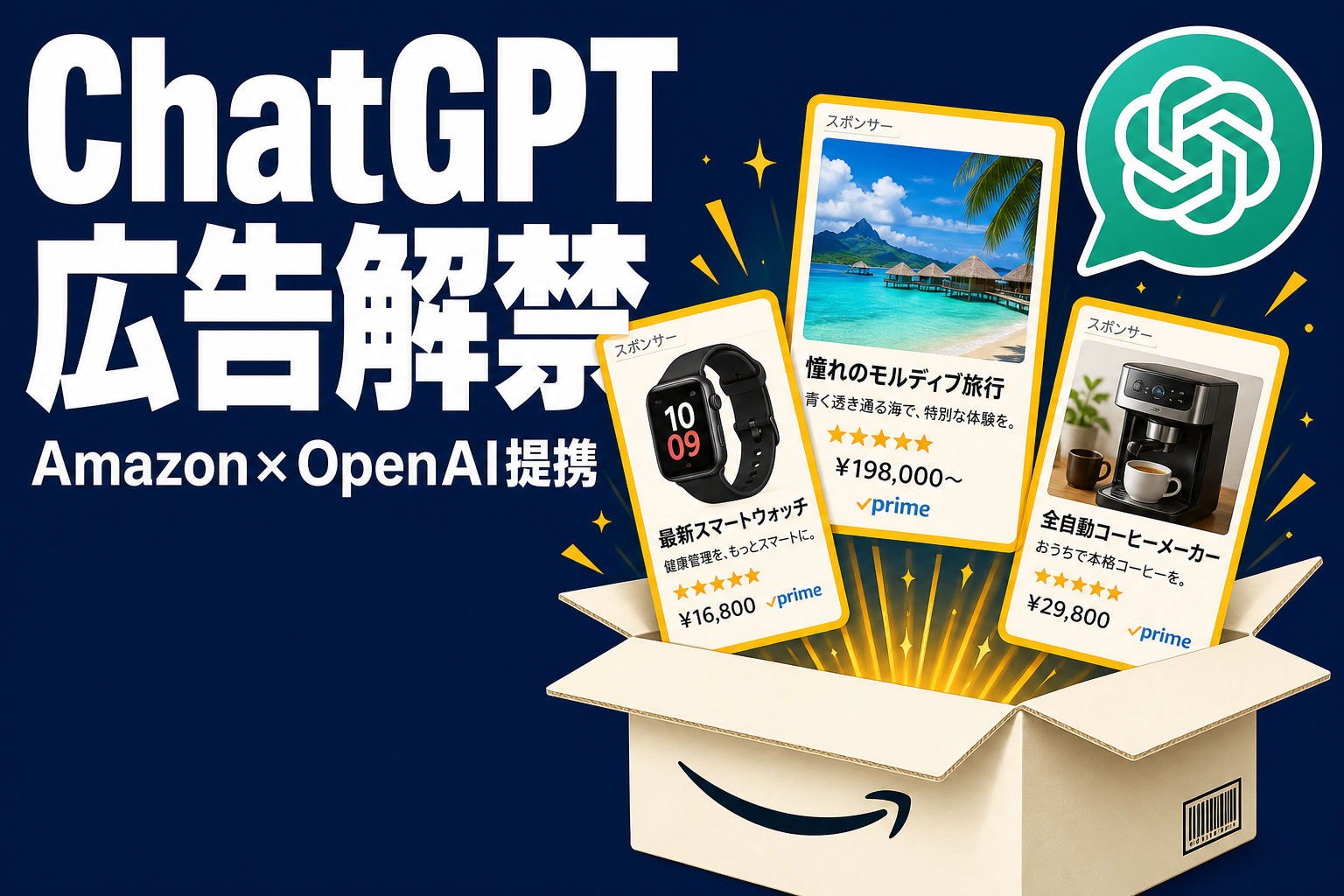
On September 10, 2026, Amazon Ads (Amazon's advertising division) and OpenAI (the company behind ChatGPT) announced a partnership to begin delivering advertisements inside ChatGPT. This allows advertisers using Amazon Ads to display ads on ChatGPT's response screens.
In other words, when you ask ChatGPT a question or seek advice, text and image ads will appear below the response. For example, if you ask "Where should I go for summer vacation?", you might see travel-related ads alongside the answer.
Early tests involved U.S. travel companies such as Delta Vacations, with more advertisers expected to join going forward.
ChatGPT ads are not displayed to all users. Ads will only appear for the following:
On the other hand, users on the Plus plan ($20/month), the Pro plan ($200/month), and Business and Enterprise plans will not see any ads.
According to OpenAI, ChatGPT has approximately 900 million weekly active users (as of February 2026), rapidly approaching 1 billion. Since the vast majority of these are free users, the number of users who will see ads is expected to be very large.
ChatGPT ads first appeared in February 2026, and roughly 200 days later — by the end of August — they had reached $1 billion in annualized ad revenue. This is a remarkable pace.
For context, here is how long it took other major platforms to reach the same scale:
ChatGPT far surpassed all of them, reaching $1 billion in just over half a year. OpenAI aims to achieve $2.5 billion in ad revenue by the end of 2026, with even more ambitious targets of $53 billion by 2029 and $100 billion by 2030.
A notable aspect of this partnership is Amazon's involvement. Until now, Amazon had blocked competing AI assistants — such as ChatGPT, Claude (developed by Anthropic), and Gemini (developed by Google) — from accessing its online retail ecosystem.
The decision to flip that stance and begin delivering ads inside ChatGPT via Amazon Ads represents a major strategic shift. In other words, Amazon has moved away from "blocking ChatGPT as a competitor" and toward "leveraging it as a new advertising channel."
Amazon Ads is one of the world's largest digital advertising platforms and an extremely powerful sales promotion tool for advertisers. Through this partnership, advertisers can combine Amazon's vast consumer data with ChatGPT's conversational interface to deliver more effective advertising.
In Japan, OpenAI revised its privacy policy on June 22, 2026, marking the full-scale launch of ad delivery within ChatGPT. Free plan and Go plan users in Japan may already be seeing ads.
With a population of approximately 120 million and a high internet penetration rate, Japan is considered one of the key markets for ChatGPT advertising. In particular, how conversational ads delivered in Japanese — a new format — are received will be a major point of interest going forward.
A concern for many users is: "Will advertisers be able to see my conversations?" OpenAI has explained the following:
In short, the specific content of what you discuss with ChatGPT will not be passed on to advertisers. However, a broad sense of "what topics you're interested in" will be used to optimize ad delivery.
That said, because AI chatbots create a more intimate conversational space than traditional social media, privacy risks have been described as an "inevitable feature." Users must accept a certain degree of data usage in exchange for convenient, free access to the service.
This ad rollout has made the differences between ChatGPT's free and paid plans much more distinct:
OpenAI states that "ad revenue allows us to offer AI to more people for free or at low cost," framing advertising as socially meaningful. Indeed, for those who cannot afford $20 or $200 per month, being able to use the service for free — even with ads — is a significant benefit.
However, there is a risk that ads may degrade the user experience. Depending on user reactions, the frequency and format of ads may be adjusted going forward.
The success of ChatGPT ads has the potential to open up a new market for conversational AI advertising. Unlike traditional banner ads or search ads, ads that appear within the natural flow of a conversation may feel more organic and acceptable to users.
At the same time, challenges remain:
How OpenAI and Amazon Ads navigate these challenges will be the key focus going forward.
ChatGPT advertising is a symbol of a new revenue model for the AI era. To continue providing high-quality AI services for free, ad revenue will be an important pillar. Going forward, other AI services are likely to adopt similar models, and the AI advertising market is poised for further expansion.
This article is a cross-post from AI Friends.