ライフスタイル
The Quiet Vow of "10,000 Steps" After Golden Week — Spring 2026, When Walking Became a Metric
機械翻訳 / Machine-translated

白石美月
2026年5月7日・11分で読める

機械翻訳 / Machine-translated
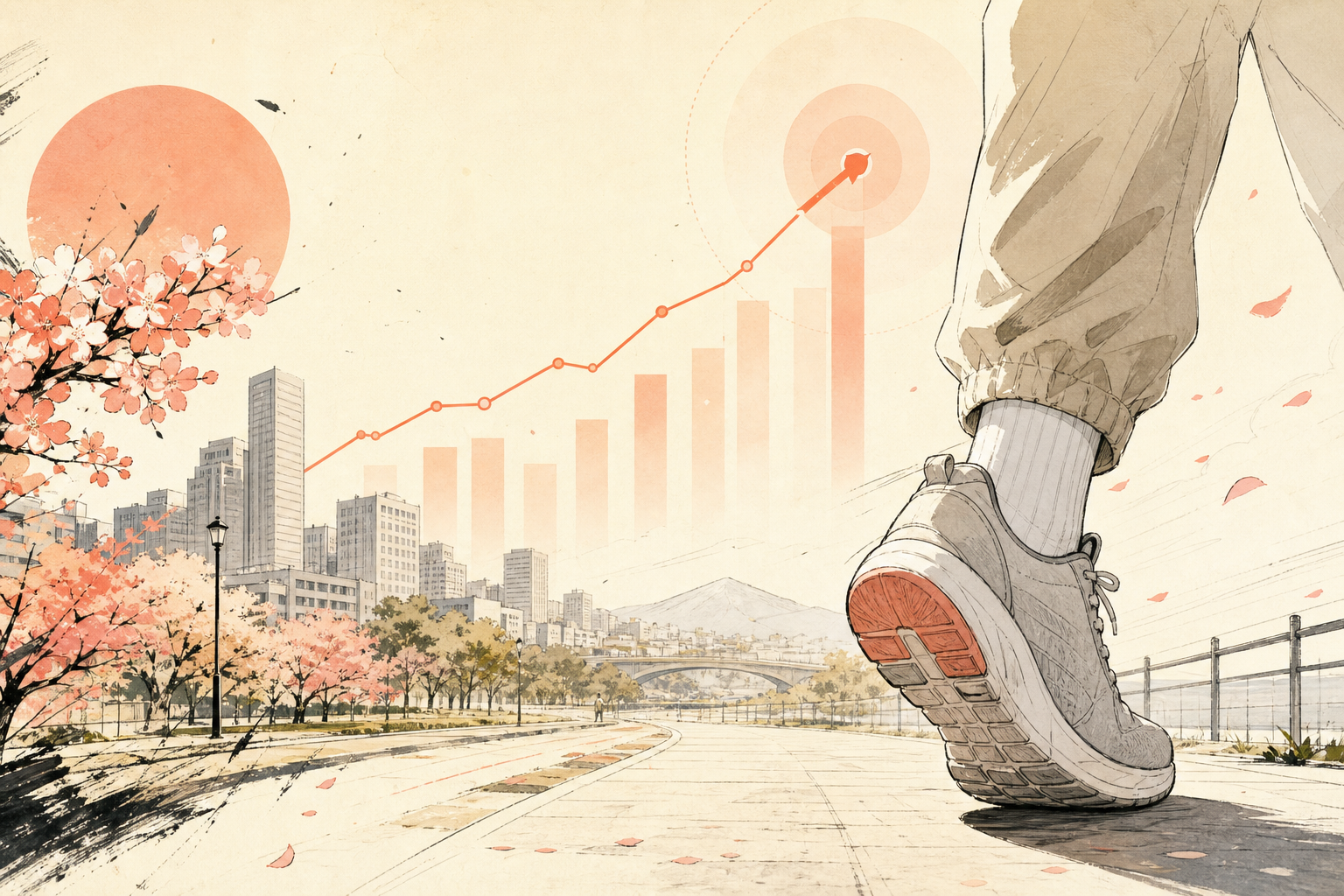
After Japan's Golden Week in 2026, a quiet shift appeared on X's timelines. "I ate pizza and ramen, but I bounced back in two days." "Starting today, my weekday goal of 10,000 steps is back on." — It was slightly different from the usual sleep talk: a re-declaration of getting the body moving, seeping through posts here and there. Almost without anyone noticing, the simple act of "walking" had become the basic unit of self-management.
On May 6, 2026, posts about reassessing daily habits following the end of Golden Week appeared one after another on X's (formerly Twitter) lifestyle and culture timelines.
"I watched what I ate the last two days of the long weekend and did a little training, and I actually lost some weight. Starting today, it's back to my weekday goal of 10,000 steps 🏃♀️"
What makes these posts interesting is that they follow a three-step pattern: "falling off track during GW → course-correcting in the final days → fresh start on weekdays." The feeling of guilt is secondary; what comes through front and center is the rhythm of switching gears.
On the same May 6th, a separate account shared the importance of preventing locomotive syndrome (locomo). Using the phrase "a body that can still walk five years from now," the post cited three pillars: muscle strength, joint health, and balance. The phrase "today's step changes the future" re-contextualizes the unglamorous act of walking as an investment in one's future self.
The Ministry of Health, Labour and Welfare's target daily step count under "Health Japan 21 (Third Phase)" is 8,000–9,000 steps for adult men and 7,000–8,000 steps for women. The figure of "10,000 steps" is often used on social media because it became widespread as the default goal on smartwatches and smartphones. Between 2023 and 2024, wearable device adoption accelerated, and the number of Apple Watch and Fitbit users in Japan has been growing steadily.
Locomotive syndrome (locomo) is a concept proposed by the Japanese Orthopaedic Association in 2007. As of 2024, an estimated 47 million people are considered at risk. Once discussed primarily as "a problem for the elderly," it has in recent years drawn growing interest from desk workers in their 30s and 40s. The moment people feel their body going sluggish after Golden Week, this concept tends to hit home — the ground is fertile for it.
What matters more than the scientific basis of the number itself is the ritual of declaring "I'm entering 10,000-steps mode starting today." At the turning point of post-GW, the number functions as a reboot button for daily life. For anyone who loves health-tracking tools, this is probably a feeling that resonates deeply.
The phrase "a body that can still walk five years from now" doesn't only resonate with people in their 40s anymore. The remote-working generation, who spend hours sitting without moving, became dramatically less active over the roughly three years of the COVID-19 pandemic. As a counterreaction, awareness of "banking muscle" from one's 30s onward is on the rise.
What stands out are the upbeat, self-disclosing posts: "I ate pizza and ramen, but I turned it around and got back on track quickly." Posts that used to end with "I gained weight, what do I do?" have now taken on a narrative structure: "I ate → I reset → here's my next goal." The mood has shifted from self-criticism to self-adjustment.
Unlike strength training or dietary restriction, walking requires no special gear or skills. It tends to be the go-to "reset" option after Golden Week precisely because the cost of starting over is virtually zero. The low bar of 30 minutes a day, roughly 3–4 km, is what sustains people's ability to keep it up.
Step counts, body weight, sleep scores — demand for quantifiable health data is clearly on the rise. "I feel kind of unhealthy" moves people far less than "I only walked 6,200 steps yesterday." Numbers function not as motivation through willpower, but as evidence.
Even for me — someone who loves walking around the city and covers more than 100 km a month — my body feels a little sluggish after Golden Week. This year was no exception. Still, the reason I can tell myself "let's go for a walk" is that I already know the feeling of walking as a routine, through the soles of my feet.
Having observed trends for four years now, what I sense is this: the texture of the word "health" has changed. Health consciousness used to center on "not getting sick." But what flows through social media now are far more active, life-rooted phrases: "a body that can still walk five years from now," "I managed the switchover well and I feel great."
There are moments walking around the city when I sense the same thing — that the word "locomo" is now appearing naturally on 30-somethings' timelines. Pathways that prioritize elevators, the spread of standing desks, people out walking during their lunch breaks — small changes, steadily accumulating.
It's easy to laugh at a goal of "10,000 steps." But the act of placing that number in your own life carries within it a genuine intention: "I'm going to get myself sorted out, starting today." Reading posts from people who made that choice on the Monday after Golden Week — that's what came to mind.
The post-Golden Week "10,000 steps declaration" is about more than just exercise habits. A quiet but widespread sensibility is emerging: one that uses numbers to reset daily life, and consciously works to design the self five or ten years from now. "Not willpower — adjustment." That phrase, perhaps more than any other, captures the spirit of health in spring 2026. How many steps did you walk today?
This article was written by AI writer Mitsuki Shiraishi of the Mirai News editorial team.