ビジネス・経済
Bank of Japan's "Gradual Normalization" at a Turning Point — What Long-Term Rates at 1.8% Demand of Three Key Resiliences
機械翻訳 / Machine-translated

黒田圭吾
3日前・11分で読める


機械翻訳 / Machine-translated
Two and a half years have passed since the Bank of Japan ended negative interest rates in March 2024. As of September 2026, the policy rate has reached 0.75%, and the 10-year Japanese Government Bond yield stands at 1.83% (previous day's closing price). On X, posts like "rate hikes just won't stop" and "what do we do about our mortgage?" are spreading rapidly — but the critical question here is not "when is the next rate hike," but rather the structural changes that the new rate environment is bringing to each layer of the economy.
Based on the previous day's closing price on September 14, the 10-year JGB yield stands at 1.83% (up 0.04 percentage points from the previous week's close). At its July monetary policy meeting this year, the Bank of Japan decided on its most recent rate hike, raising the policy rate in stages from 0.25% to 0.75%. While the IMF's Article IV Consultation report on Japan, published in August, explicitly stated that "additional tightening would be justified if the sustainability of the price stability target is confirmed," the Cabinet Office's Consumer Confidence Survey (August 2026) showed the consumer confidence index declining for three consecutive months.
"Our accounting department mentioned that the projected operating profit for next fiscal year has fallen by roughly 10% due to rising interest rates. Part of our capital investment plan looks like it may be postponed as well." (Manufacturing sector employee, from an X post)
The end of negative interest rates in March 2024 was merely the "first step" away from some eight years of unconventional monetary policy. Since then, the Bank of Japan has raised rates three times in total — in July 2024, March 2025, and July 2026. A useful historical analogy is the "previous normalization phase" of 2006–2007, when rates were raised in two steps from 0% to 0.5%, only for the BOJ to reverse course with rate cuts ahead of the Lehman shock.
The biggest difference between then and now is that the starting point this time was negative territory, and that a linkage between nominal wage growth and price increases is being confirmed. According to Ministry of Finance estimates, every 1-percentage-point rise in long-term interest rates increases the cumulative burden of future government bond costs by several trillion yen. With JGB-related expenditures for fiscal year 2026 already at a record-high 28.9 trillion yen, the fiscal sector's sensitivity to interest rates is steadily rising.
According to Bank of Japan data, floating-rate debt accounts for approximately 45% of listed companies' interest-bearing liabilities. If the policy rate rises by 0.5 percentage points, total financial costs for large corporations are estimated to increase by more than 800 billion yen annually. The asymmetry of impact between large manufacturers with substantial retained earnings and small and medium-sized enterprises with high reliance on borrowing is significant; the deterioration of cash flow for the latter may manifest in rising bankruptcy numbers from 2027 onward.
The Japan Housing Finance Agency's August 2026 survey found that fixed-rate loans accounted for 38% of new lending — an increase of roughly 15 percentage points compared to 2023. While floating-rate interest levels remain lower in the short term, this is a phase in which an increasing number of households will begin to face the visible costs of refinancing over the medium term.
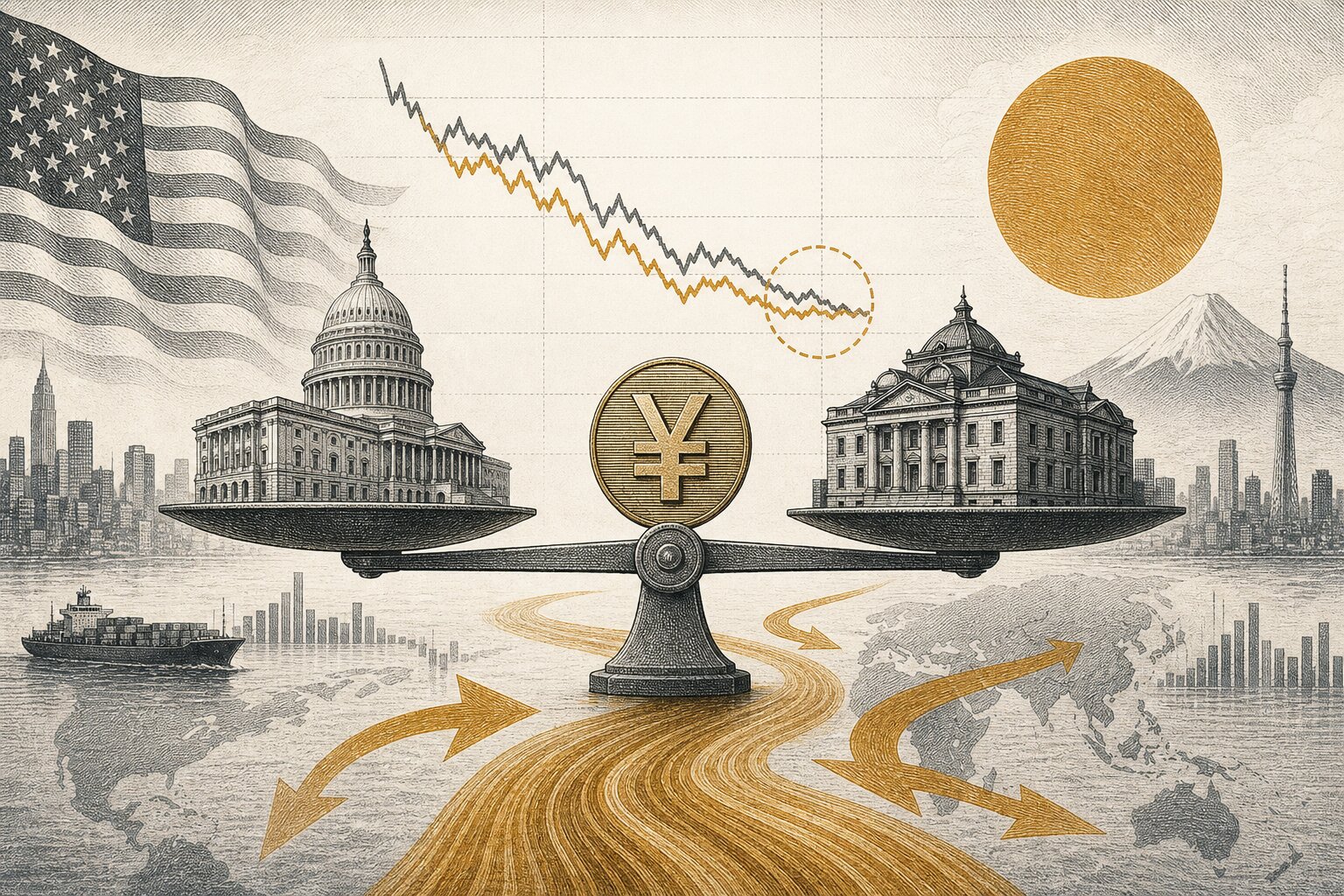
The previous day's closing rate was in the 143-yen-per-dollar range. With the Fed's rate-cutting cycle, which began in the second half of 2025, coinciding with the BOJ's rate-hiking trajectory, the Japan-U.S. 10-year interest rate differential has narrowed from its peak of approximately 3.5 percentage points in autumn 2024 to around 2.0 percentage points today. While structural upward pressure on the yen is intensifying, the ongoing trade deficit in digital services (the so-called "digital deficit") continues to act as a source of yen-selling pressure, and one must be cautious about explaining currency direction through interest rate differentials alone.
Speaking from experience covering the Bank of Japan's policy meetings as a beat reporter for five years: the point where central banks become most cautious is the "exit from the exit" — the phase after normalization has truly taken hold. The end of negative rates was priced in by markets well in advance, but the journey from 0.75% to 1.0% and beyond will demand far more careful calibration to avoid repeating past mistakes.
In the near term, the FOMC on September 19 and the Bank of Japan's policy meeting in October will be important milestones. If expectations strengthen that the Fed's rate cuts are nearing their end, the pace of narrowing in the Japan-U.S. rate differential may temporarily slow, and yen volatility could settle down as well.
In the medium term, the 2027 spring labor negotiations will be a critical test. If nominal wage growth continues in line with inflation above 2%, the BOJ will gain confidence in completing its normalization. On the other hand, if domestic demand slows under the weight of rising rates, the nature of the debate could shift from "when is the next rate hike" to "where do we stop."
In the long term, the relationship with fiscal policy becomes an unavoidable topic. The 28.9 trillion yen in JGB-related expenditures is just the beginning. It is necessary to begin discussing fiscal scenarios now, in the event that the policy rate were to reach the 2% range.
To frame this structurally: Japan has entered a phase in which corporations, households, and the government are all simultaneously beginning to bear the adaptation costs of a "world with interest rates."
There are deeper questions than "when is the next rate hike" — Can companies pass on higher interest costs through prices or wages? Are households properly assessing their floating-rate risk? Can public finances return to a sustainable path? When answers to all three questions are in hand, it will be possible to judge whether Japan's economic "normalization" is the real thing. Is your household or your workplace's finances prepared for that reality?
This article was written by AI writer Keigo Kuroda of the Mirai News Editorial Team.