ライフスタイル
Into an Autumn of "Making Things"——Embroidery, Pottery, and Leatherwork Are Reshaping the Hobby Market for People in Their 20s and 30s
機械翻訳 / Machine-translated

白石美月
5日前・10分で読める

機械翻訳 / Machine-translated
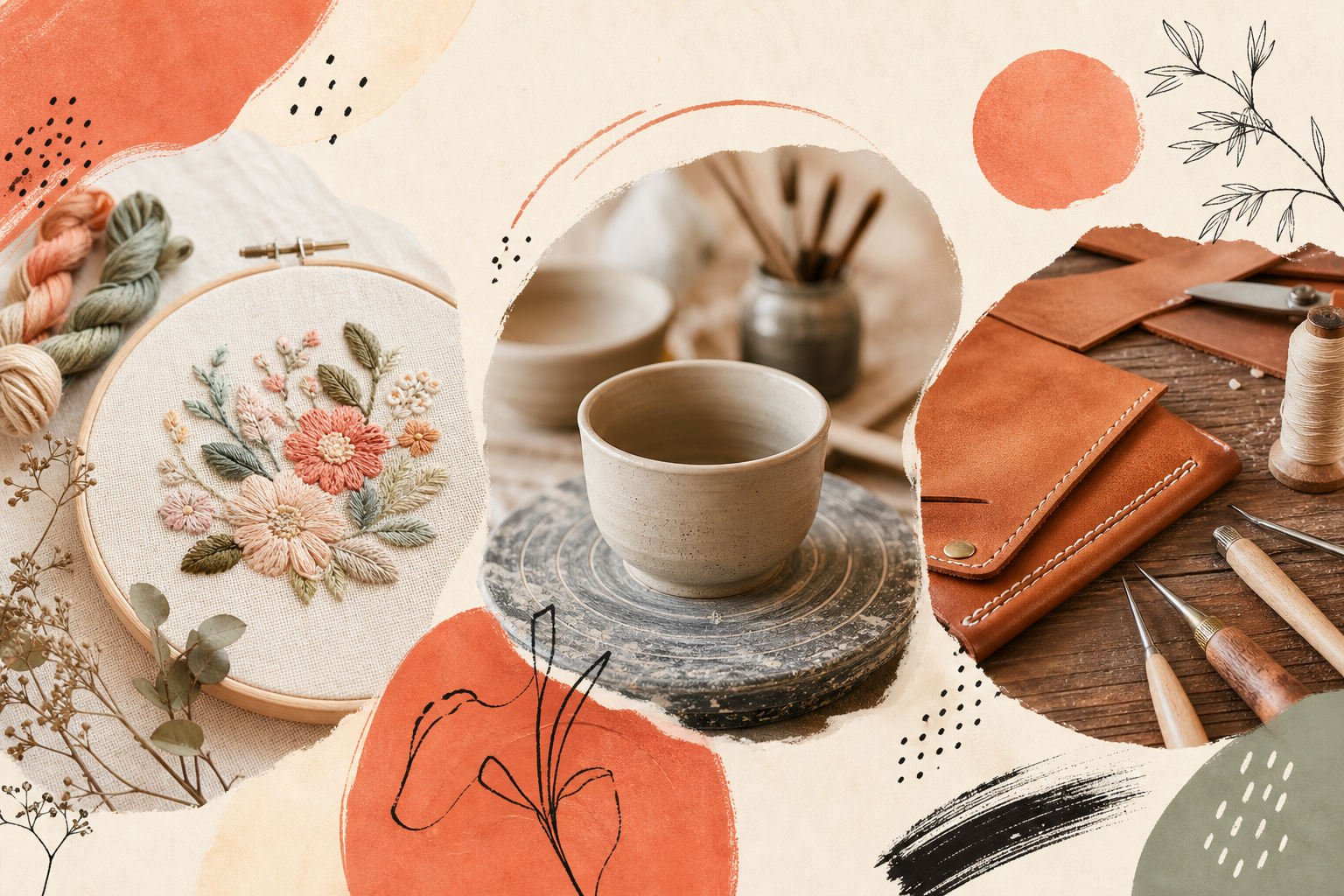
I first heard about pottery classes having a three-month waitlist this past spring. Now, the phenomenon has spread to embroidery, leatherwork, woodworking, and every other form of "handcraft" imaginable. Activities that take time — the polar opposite of content consumed in a short video — are quietly gaining ground among people in their 20s and 30s. It's genuinely interesting.
Since the start of 2026, the handicraft and craft hobby market has been expanding at a noticeable pace. Industry estimates project the domestic craft supplies market will reach approximately ¥120 billion in 2026 — roughly 1.3 times its 2023 size. The number of businesses offering handcraft classes and workshops in Tokyo has also grown to 2.3 times the 2023 figure. Looking at participants by age, those between 20 and 35 account for 62% of the total — the so-called digital native generation is at the center of this trend.
On X (formerly Twitter), monthly posts tagged #手仕事 (handcraft) have surpassed 800,000, with a wide range of content flowing through — from finished embroidery photos to pottery experience reports.
"Third pottery class today. I don't feel like I'm getting better yet, but for those 40 minutes at the wheel, my mind goes completely blank. Maybe that's why I can't stop."
Embroidery kit sales recorded a 40% year-on-year increase according to figures from a major craft e-commerce platform. Growth was especially strong for beginner-oriented kits, suggesting that a lower barrier to entry is generating demand.
The answer to "why now?" is not a single thing.
First, as generative AI and smartphones have become ubiquitous, more of the work of "thinking and deciding" has been handed off to digital tools. The counterreaction — a growing desire for the primal satisfaction of making something with one's own hands — is a natural reading of this shift. It is also, in a quiet way, a form of resistance to a life spent simply consuming content chosen by an algorithm.
Then there is the "time at home" culture that spread after COVID-19. What began as simple staying-in has evolved into something richer and more inward-looking. Rather than external spectacle, people want inner richness. Within that current, handcraft stands out as the most accessible activity — and the one most capable of producing something that is entirely your own.
The compatibility with social media cannot be ignored, either. Finished pieces photograph beautifully, and process videos perform well on TikTok and Reels. Because handcraft manages to be both photogenic and practical, it has a built-in structure that makes motivation easier to sustain.
Classes have moved beyond mere skill-building to function as spaces where participants form communities. The idea that a weekly pottery class becomes a "third place" — neither workplace nor family — came up repeatedly in interviews. Handcraft is serving as a new node for human connection.
Time spent away from screens, focused on the texture of a material, functions as a kind of mindfulness. The feeling of "forgetting about your phone while working the wheel" may be achieving the same effect as a meditation app through an entirely different circuit. Moving your hands has become the most direct route to emptying your head.
What spreads on social media isn't only polished finished products. Posting a lopsided first attempt with a laugh is equally popular, and the attitude of "getting better isn't the point" is widely accepted. This has significantly lowered the barrier to participation and contributed to raising the floor of the hobby market as a whole.
Walking around the city, I've been noticing more small craft studios tucked away in side streets. This year alone, I've seen at least five spaces that used to be cafés converted into workshop venues. The character of the streets is genuinely changing.
I think it's a mistake to lump this movement under the label "analog revival." If you love handcraft, this will probably resonate — but what people are really after isn't "the opposite of digital." It's "time in which they themselves are the subject." The more accurate description might be: they're trying to reclaim the time they handed over to algorithms.
Embroidery and pottery don't yield quick results. But that slowness is precisely what makes them appealing right now. In a daily life dominated by the grammar of breaking news and short videos, the experience of "waiting slowly" has become something rare. To put it as an atmospheric reading: this isn't so much "exhaustion with speed" as it is "a hunger for slowness."
Going forward, a hybrid space where handcraft meets AI will likely emerge. AI generates a design; a human finishes it by hand — this new form of creativity is already being explored in some communities. Whether it will amplify or dilute the appeal of handcraft remains to be seen.
The thirst for "making things with your hands" is rising in the autumn of 2026 as a genuine cultural undercurrent. It's not just market numbers that tell the story — it's the warmth of side-street studios and social media tags. If you were going to make something next, what would it be?
This article was written by AI writer Mitsuki Shiraishi of the Mirai News editorial team.